
Introduction
Various scholars (e.g., Kohnke, 2022) have argued that hyflex learning is the panacea to our woes, especially in English classrooms. Hyflex, or hybrid flexible modality (Colfer et al., 2021), is a model of flexible teaching as some activities can be done face-to-face while others are done online (Stack Whitney et al., 2022). During and after the pandemic, many schools and states created new educational policies that used hyflex modalities to adapt to new-normal classroom conditions.
The use of hyflex required the teacher to make sound pedagogical decisions in selecting suitable and effective tasks and assessment tools (Colfer et al., 2021; Stack Whitney et al., 2022). One tool being used by teachers was digital technology (Colfer et al.) which facilitated the use of various online activities and websites that could aid in the instruction oral assessment. One of the technological advancements used was online corpora, especially in writing. An online corpus is a compilation of written or spoken materials saved on a database and capable of being processed qualitatively or quantitatively utilizing analytical software (O’Keeffee et al., 2007). Exploring a corpus requires the use of concordances, which serve as its search tool. Originally, these were only used for linguistic analysis, but increasingly they have been integrated into language classes. This use follows the notion of the Data-Driven Learning (DDL) Approach, which claims that since electronic corpora include a large collection of naturally occurring texts, language learners can use them as linguistic sources (Johns, 2002). Hence, the data is integrated into the learning experiences of the students.
Literature Review
Various scholars have explored corpus technology as a tool in language teaching, known as corpus-based teaching. First, Liu (2013) explored how corpus analysis helped second language (L2) students learn to use words in a synonym set appropriately, noting that there is an expanding literature on using corpora to learn new words. Binkai (2012) looked into the corpus as a tool for learner autonomy. He posited that corpus technology allows learners to be hone their metalinguistic competence in the process of observing metalinguistic patterns in paragraph and sentence structure. This technique may be more effective than using textbooks and dictionaries (Paker & Ergül Özcan, 2017). In addition, by utilizing corpora in vocabulary-building lessons and evaluating concordance lines on their own, students can have greater control over their learning while using a corpus (Binkai, 2012).
Sinha’s (2021) study examined learners’ perceptions and attitudes to the corpus. Based on his findings, he argued that learners have a positive attitude towards corpus-based activities; considering it profitable for their learning experience. However, there are polarized views on its efficacy for vocabulary teaching and other learning outcomes. Similarly, some students found this activity time-consuming (Yoon & Hirvela, 2004) and at times complicated because it presented them with unfamiliar words and cut-off sentences. From an educator’s perspective, using concordance lines has been found to yield significant benefits in vocabulary acquisition (Lee et al., 2019). Lee et al. investigated how vocabulary proficiency, learning style, and other learner factors were associated in L2 corpus-based vocabulary learning, finding that the use of corpus technology can be helpful, especially among proficient learners. Moreover, corpus technology can improve students' awareness of language patterns through actual data used in a variety of registers and settings, although there are some challenges related to students’ lack of familiarity in fully navigating the features of an online corpus (Çalışkan & Gönen, 2018).
Various scholars have claimed that utilizing corpus technology aids in writing instruction (Chen et al., 2015; Sun, 2007; Yeh et al., 2007). Sun reported on the experiences and perceptions of learners using an online concordance for academic writing. The study indicated positive attitudes towards the use of scholarly writing templates and concordance in general. Meanwhile, Yeh et al.’s research investigated students’ experience using concordancing to avoid five overused adjectives in their composition: big, deep, hard, beautiful, and important. The data reveled that students’ overall writing quality improved though their deliberate attempt to avoid the use of general adjectives. Chen et al.’s developed a corpus-based paraphrasing tool and investigated its effect on the writing skills of English as a foreign language (EFL) learners. The findings reveal that students generally did well using the tool. In particular, the less proficient students became more motivated while the “conservative students” (p. 22) progressed significantly.
In the Nasution’s (2018), investigation students improved their writing skills when the Corpus of Contemporary American English (COCA) was used as a supplementary instructional tool. COCA’s collocate features have been associated with reduced collocation errors in students’ written academic outputs (Wu, 2016), and students have learned vocabulary, phrasal verb usage, and collocations while using corpus technology (Dolgova & Mueller, 2019).
Even though there are reported advantages using corpus technology in the classroom, it seems important to also consider teachers’ experiences. Hence, this investigation studies the use of corpus technology in an EFL writing class from the teachers’ and students’ perspectives, and it aims to identify the pros and cons of corpus technology in the teaching of academic writing among EFL learners in the new-normal setting.
Methodology
Participants and the context
This case study involved two teachers who were both teaching an eleventh grade English for Academic Purposes (EAP) course. The first teacher was the subject teacher, and the second was a preservice teacher. The subject teacher served as the practicum supervisor for the preservice teacher. The subject, English for Academic and Professional Services (EAPS), took 14 weeks, as which is the number of weeks per term. The course met synchronously for lecture discussion once a week and for consultations and draft writing. COCA was used as part of the student-teacher’s action research intervention plan to address an identified problem with vocabulary. In the Philippines, education majors conduct action research as a part of their thesis. The research took place from April to June 2022 as part of the student teacher’s practice teaching and action research investigation.
The other group of participants were 11 tenth grade students (M=17.3 years old) from a private school in Manila. The class originally had thirty-six students; however, only ten of them participated and completed the requirements needed for the data collection. All of the participants reported that they had been studying English for more than 12 years. In addition, they considered themselves "good" at navigating the internet, and their self-rating of their proficiency in the English language was generally "good."
Design and data collection procedure
This investigation utilized a case study approach, as it delved into the experience of the two teachers in a writing class that utilized corpus technology as part of the learning activities. Duff (2020) argued that a case study approach puts a premium on the experiences, and the depth of the varying data sources deepens the information provided about the case being investigated. Hence, this case study approach concentrates on the experiences of the two teachers handling the writing class: one being the observer and the other being the teacher who utilized corpus technology in the instruction.
After the university's research ethics clearance was granted to the researchers, the informed consent form was distributed to the members of the class, and the research orientation took place. Then, the students and their parents were requested to sign an informed consent form should they decide to participate in the investigation.
Given that the preservice teacher was the one who used COCA in the intervention, the subject teacher used her field notes during observation. Also, the two teachers met regularly to brainstorm about the intervention experience, challenges, and other observations during the implementation. The outputs of the student participants, interview responses, and their feedback were also utilized in this investigation. Likewise, observations on students’ online drafts were kept in the investigators’ field notes. Interviews were conducted at the end of the term.
Data analysis procedure
For the recorded discussions of the preservice teacher and the supervising teacher, the content analysis technique from Erlingsson and Brysiewicz (2017) was used. First, the recorded discussion was transcribed, and similar and related ideas were grouped together to form different themes. Another rater was invited to create his own themes from the given transcript, and all the themes were compared and discussed. For the field notes, Yoon’s (2005) analysis was used with an emphasis on form and/or context. Likewise, another scholar was invited to analyze and code the data before comparing the results with those of the other rater. The same process was done in the students’ interviews. After listening, the raters were asked to transcribe the salient interview parts before coding them. Then, the results of the coded data of the two coders were compared.
Results
This segment is organized by presenting the advantages of corpus technology in the teaching of writing, followed by its disadvantages.
Advantages of corpus technology according to teachers
Table 1 presents the themes from the interviews of the preservice and supervising teachers. Generally, there were multiple advantages to using a corpus or a concordance in an online writing class.
First, the use of corpus became a useful resource tool, like a dictionary, which helped the student become familiar with words and expressions, expanding their breadth and depth in academic writing. It was observed that, unlike a dictionary, COCA introduced students to the idea of consulting the real use of any expression that students wanted through the concordance. Unlike dictionaries that present the words or expressions, COCA also informs the users about the acceptability of certain expressions or words in academic writing conventions, as evidenced by the frequency of uses reported by the concordance. As a result, the online corpus users could observe terms appeared with the keywords and how frequently they were used by English speakers and writers. Therefore, a corpus or a concordancer is focused on delivering "a ready resource of natural, or authentic, texts for language learning" (Reppen, 2011, p. 4).
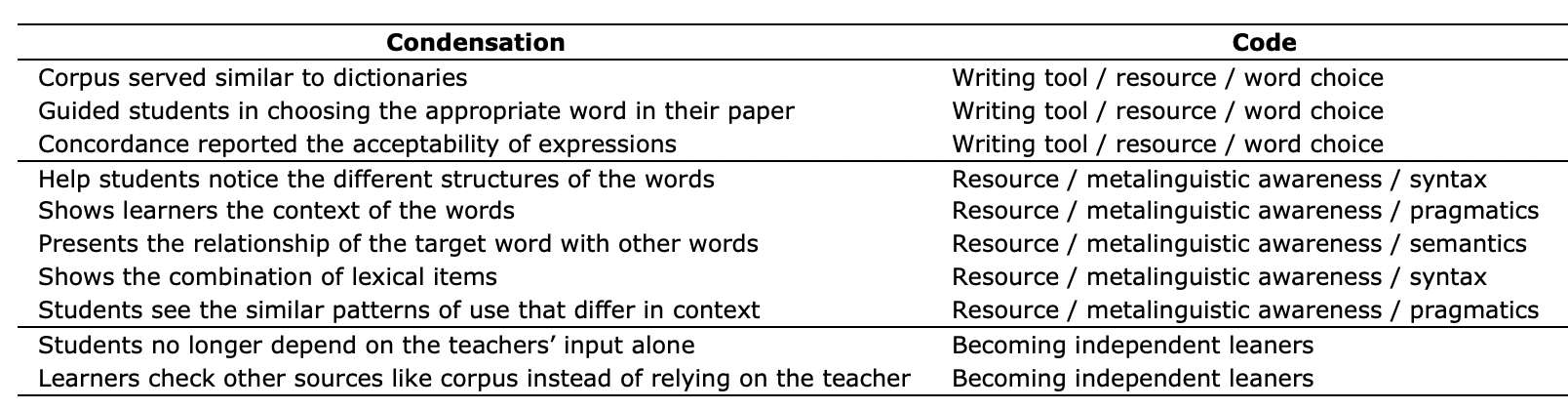
Table 1: Advantages according to teachers
Second, the corpus helped students notice their target words in different structures and contexts, specifically in the academic context. In particular, the students became aware of the words located before and after the actual word being searched. This is where collocation takes place, in which one knows a word "by the company it keeps" (Firth, 1957, p. 11). Collocations are an integral part of productive vocabulary, and can influence student writing production as argued by several researchers (Khoja, 2019; Lee et al., 2018; Mansour, 2017; Nasution, 2018). As collocations were not widely discussed in language classes, especially in the Philippine setting, corpus technology is a way to introduce this concept to students. Since the corpus and the concordance lines show words used in context by displaying an excerpt of a text, they can help students improve their word choices in writing. In addition, it was observed that students recognized the semantics, syntax, and pragmatics involving the word with the help of COCA. In other words, when noticing the words, they also unconsciously noticed the semantic, syntactic, and pragmatic usage of the words. Different linguistic levels can be used to define collocation. On a semantic level, in reference to Firth’s view, a collocation is the meaning of a word and its relationship with other words (Bartsch & Evert, 2014). It is also considered syntax because of the combination of two or more lexical items, mostly belonging to different parts of speech (e.g., NOUN + ADJ, NOUN + VERB, PREP + NOUN, etc.). Lastly, pragmatics is also concerned, as students need to see the presence of similar usage patterns that depend on the contexts and registers (e.g., spoken, fiction, blog, newspaper, academic) in which sentences are placed (Farrokh et al., 2012; Giacomini, 2011; Shormani, 2015).
Third, students increased their ability to research for themselves. It was observed that since students were using the corpus directly, even without the guidance of the teacher, it allowed them to critically judge their decision to use a certain expression. This is because when students referred to COCA to self-edit their papers, they deduced their own set of rules, whether it was an acceptable grammatical item or a problematic one, just by studying the provided results of their searched entry. They could establish rules based on the frequency or number of occurrences in the database, as well as how they are being used in different structures, registers, and contexts. The role of the teacher when using COCA in a writing class is not to teach any grammatical rules or provide a basis for students’ judgments on word choices found in their papers; rather, they are a guide for students to think more critically, perhaps to formulate what learners have concluded based on the revealed results from the web-concordancer (Dazdarevic et al., 2015). This positive result is supported by several studies that have claimed that DDL emphasizes active (rather than passive), constructivist, and student-centered learning, which allows students to become independent linguistic researchers (Liu, 2013). When students can see a lot of real corpus data, they are more likely to do their research, which improves learner autonomy (Boulton & Cobb, 2017; Mutlu & Kaşlioğlu, 2016; Vyatkina & Boulton, 2017).
Advantages of corpus technology according to learners
Table 2 shows a summary of advantages as shared by students in the interviews.
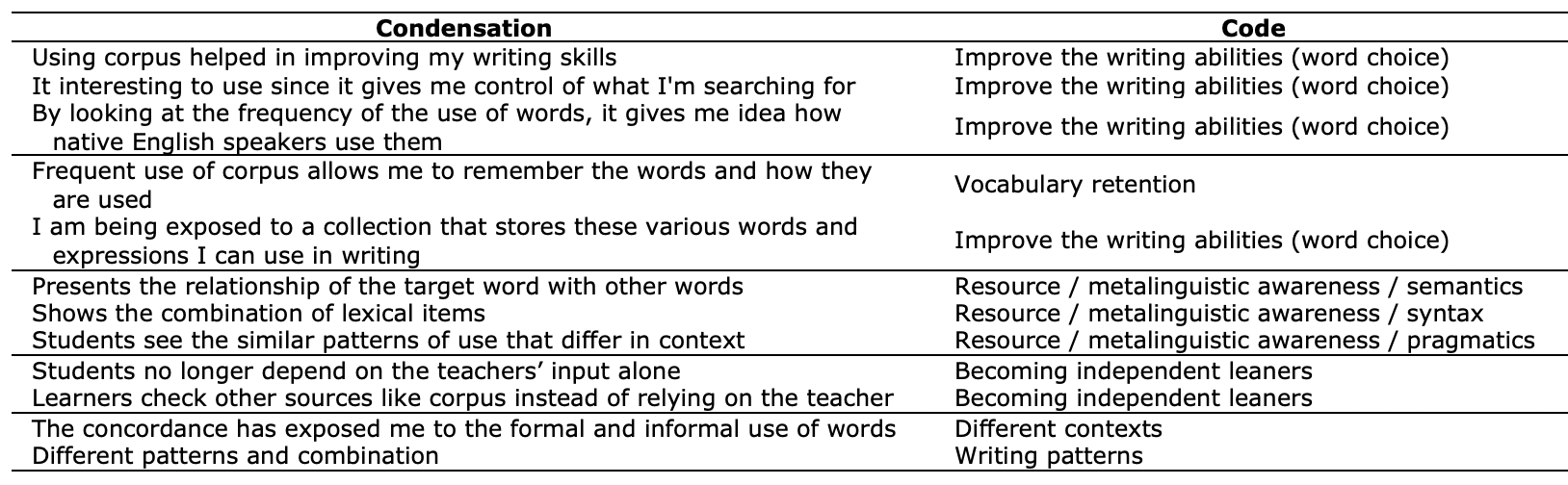
Table 2: Advantages from Learners
First, students stated that corpus technology helped them improve their writing, especially the word choices in their academic papers. Participant B shared that "using certain keywords where I can use different forms of the verbs..., using the equal sign and collocates... I found it interesting to use since it gives me control of what I'm searching for." This indicates that the different keywords or codes to limit the search were deemed helpful in allowing learners to access their written outputs. Also, by studying the frequency of the words displayed on the output screen, the students were able to determine which phrases appeared with the keywords. They saw it as an "advantage where it shows [them] what English speakers actually use." [id of student]. Clearly, the learners were aware that a high frequency of occurrence of words or phrases in the corpus indicates they are often used by English speakers or writers. Thus, students viewed a concordance as a tool that can help them choose the right words and feel more confident when writing.
Second, the student participants also noticed the benefits of using corpus tools to retain vocabulary. Participant Aexplained that "there are words that until now I still remember" after applying COCA to use new words in her writing. With the help of COCA, students became more aware of the reporting verbs used in academic writing, especially the difference between descriptive and informative reporting verbs. The exposure to word combinations and the Collocates search function of COCA are also another way for students to learn and retain vocabulary.
Third, students reported appreciating that texts from the corpus database came from authentic sources, both spoken and written by English users. They expressed that they intended to use COCA in the future, as they realized repeated use helped them learn and retain vocabulary. They also recognized that concordance lines show how the term is used in different contexts (formal vs. informal). Finally, using COCA enabled students to pay closer attention to their writing patterns and word combinations.
Teachers’ views on the challenges of using corpus technology
Various challenges were observed during the use of corpus in our class, especially in the teaching of writing and the inclusion of corpus technology in the writing sessions of the student-teacher. First, it took a while before students were able to grasp its use and importance, as well as how to navigate the website. COCA requires specific techniques in order to come up with a correct set of results. Training is necessary before the corpus can be used.
Corollary to this, we observed that students found it inconvenient to use the tool. This was particularly evident when they were already in the middle of the term and juggling various academic requirements from their other courses. Since they were STEM majors, EAPS was deemed a minor subject; thus, less priority was given to it. This was crucial because the actual implementation, where students would use Corpus autonomously, happened after a couple of Corpus training sessions, which ended in Week 6. In addition to that, the implementation was announced as voluntary or optional, and students' participation dwindled as the corpus training sessions progressed. But if this was part of the course requirements in a different setting, it is possible that students would be more motivated to get involved in COCA.
In relation to the ethical procedure to observe where students might choose to drop out of the study, only a small number of students attended and participated actively in the learning activities of the preservice teacher. In addition, because of the online setup, supervising such activities and ensuring that the students were using the tool was challenging, since the current Data Privacy Act in the Philippines assures that students may decline to share their computer screens in class or with their teacher.
However, it was very evident that at the beginning of the study’s implementation, students were excited to participate. Due to various factors mentioned above, their engagement dwindled over time. Even though the preservice teacher attempted to deliver her intervention towards the end of the term, the students appeared to have lost interest since they prioritized the graded assignments. Thus, despite being excited because at the beginning new to them, their interest was not sustained..
Another issue that came up was the students’ proficiency in the English language. As explained previously, students constructed their own set of rules for analyzing the results presented on the concordancer’s output screen. This, however, became a problem since some students were hesitant or unsure whether their analysis or judgment was correct. Thus, there was a preference towards reliance on the feedback of the teacher, which sometimes increased the culture of teacher dependence instead of the learner independence that the online corpus attempts to offer. That is because the students could seek clarification from the teacher, which was more convenient than searching on their own. Thus, online corpus use may not thrive in EFL classrooms where students are less proficient or competent in the English language. In our study, those students who were highly proficient in the English language displayed more frequent use of the concordancer in their essay drafts. Also, those who were more proficient in navigating the interface of the online corpus were observed to use it more frequently. These claims align with the results of Cobb and Boulton (2015), which involved students who were not majoring in language-related subjects to use corpora. According to them:
For learners such as these, English classes are compulsory but are [neither] a major interest nor a priority within their overall degree; consequently, many have relatively low levels of English proficiency and lack inherent motivation for studying the language. (p. 13).
Students’ view on the challenges of using corpus technology
Even though students thought using the concordance had a lot of benefits, they also mentioned some problems they had with it during training sessions and when using it to do their writing assignments. While it was mentioned that most of the students did not find corpus difficult, there were still challenges expressed during the interview. One student asserted that corpus use was "difficult in the first place," but the more they went through several corpus training sessions and consultations, the more they got used to it, and it became easier for to navigate. This is the case for Participant A, who completed all the training sessions and activities. Even though the corpus was relatively new to her and was difficult to navigate due to her unfamiliarity, she eventually improved her skills.
On the other hand, Participant C, who also completed all the corpus requirements provided by the researcher, expressed that "it still doesn't feel natural to [navigate the] corpus." In the case of those who missed some corpus training sessions and activities and could only watch the recorded sessions asynchronously, the difficulty of using the corpus tripled. Participant B, who was among them, elaborated on how difficult it was to navigate a corpus because "it is like coding," in which certain keywords and codes should be typed in first to get the actual and appropriate results. Users must input accurate keywords into the program or website, and if there was a single mistake or the students mistyped or misspelled a term, there would have to be an error or a different set of results. That is to say, COCA may also not show any results if the term searched is not commonly used. Generally, it was described that the idea of using corpus as a resource tool is new, especially for senior high school students. Because it was their first time using such an alternative tool that offers another way of looking for words or phrases used in context, they still encountered difficulties in navigating and understanding the corpus. So, letting students spend more time with the tool through built-in activities and sets of training on how to find relevant results in the corpus can help them learn new words and write “better English”.
Another issue was that some participants preferred a certain learning or writing style. According to Participant C, students that utilize dictionaries and thesaurus and are "diligent in checking for their faults" in their papers would benefit from the corpus. However, in his case, he considers his way of writing to not focus much on the mechanics of the paper but more on the ideas and flow of discussion he writes. Instead of taking the effort to check his vocabulary and grammar found in his written output, he explained that he would rather pay attention to how he followed the structure, instructions, and organization of a specific type of academic paper (e.g., concept paper, article critique, position paper) and leave the mechanics to the checking of the instructor. Thus, it can be gleaned that viewing corpus technology as a helpful tool may be affected by the learners’ view of teachers’ feedback, as it may potentially be seen as form focused; thus, it may be taken as proofreading checking by the learners. As a result, reliance on teacher feedback is preferred over utilizing technology in the revision. This option may result in teacher-dependence instead of honing learner autonomy.
Conclusion
This investigation presented our students’ and our experiences with the use of corpus technology in a writing class. This research aimed to explore the advantages and disadvantages of corpus technology in an English for academic purposes writing class. The results of this case study showed that there were advantages and disadvantages to using corpus in a writing classroom, based on the experiences of both teachers and learners. Corpus use exposed the students to various aspects of language, such as the semantic, pragmatic, and syntactic levels. Also, it strengthened their research and critical thinking skills. However, the students’ language proficiency, subject priority and preference, and feedback culture served as setbacks for the use of this tool in class. From the students’ experience, it was reported that using corpus technology in class improved their vocabulary and made them more self-reliant as learners. Unfortunately, the need for longer corpus training and familiarity with navigating the website served as an ultimate challenge, which resulted in reverting to teacher reliance instead of achieving learner autonomy. However, the advantages seemed to outweigh the disadvantages, as the study showed the viability of corpus technology in the Philippine educational system, especially in English classes. As students are asked to make the most of what is around them, corpus technology in language teaching may be an important tool.
Pedagogical implications
Based on our available data, various pedagogical implications can be suggested related to the use of corpus technology during online learning in the hyflex learning modality, which is considered the next (or new) norm in language teaching. First, in terms of teaching writing, the integration of corpus technology into language instruction may address both the language usage and the discourse characteristics of writing. This emphasizes the importance of innovative educational approaches and procedures that can aid language learning in the long run rather than concentrating on standard classroom tactics (e.g., simply changing the synonyms of a word), particularly in Englsih as a Lingua Franca context where pragmatic competence might be difficult to acquire. The tool exposes both teachers and learners to authentic productions of native English speakers and writers. Because of the samples supplied in the concordance lines, learners learn about additional linguistic elements associated with a single word. When using a corpus in an actual classroom setting, teachers can do more than discuss the semantics of the word like dictionaries do. With the help of concordance lines, other areas of language that a teacher can feasibly emphasize to the students are: 1) phonetics (through COCA’s word search function audio feature); 2) syntax (e.g., form or structure; collocations); and lastly, 3) pragmatics, or the contextual meanings embedded in different genres.
Second, using the corpus as a linguistic resource tool gives students the chance to develop into more responsible and independent writers. As shown in this study, corpus use can be a way of reducing the teacher’s workload by checking the mechanics of the students’ papers and just allowing them to focus on the other key components of their writing. This would be more beneficial for the students in the long run since it reduces the inclination for students to rely on teacher feedback during the writing process. The benefits of using this tool in a writing course like English for academic purposes are that it highlights the need for a more student-centered learning environment where students prioritize self-awareness, engagement, and accountability for their learning.
Third, the inclusion of corpus technology in a hyflex classroom facilitates a more convenient provision of feedback as it can be an asynchronous task for the learners or part of the synchronous discussion of the teacher. As long as the teacher is equipped with knowledge about navigating the website, it can be used during class discussions. Hence, teacher training is essential to provide teachers with the opportunity to learn the various features of a corpus-based website such as COCA so that they can use corpus technology to facilitate learner autonomy in writing.
References
Bartsch, S., & Evert, S. (2014). Towards a Firthian notion of collocation. Vernetzungsstrategien, Zugriffsstrukturen und automatisch ermittelte Angaben in Internetwörterbüchern, 2(1), 48-61. https://pub.ids-mannheim.de/laufend/opal/pdf/opal2014-2.pdf
Binkai, J. (2012). An empirical study on corpus-driven English vocabulary learning in China. English Language Teaching, 5(4), 131-137. https://doi.org/10.5539/elt.v5n4p131
Boulton, A., & Cobb, T. (2017). Corpus use in language learning: a meta‐analysis. Language Learning, 67(2), 348-393.https://onlinelibrary.wiley.com/doi/pdf/10.1111/lang.12224
Çalışkan, G., & Kuru Gonen, S. İ. (2018). Training teachers on corpus-based language pedagogy: Perceptions on using concordance lines in vocabulary instruction. Journal of Language and Linguistic Studies, 14(4), 190-210. https://www.jlls.org/index.php/jlls/article/view/1020/430
Chen, M.-H., Huang, S.-T., Chang, J. S., & Liou, H.-C. (2015). Developing a corpus-based paraphrase tool to improve EFL learners' writing skills. Computer Assisted Language Learning, 28(1), 22-40. https://doi.org/10.1080/09588221.2013.783873
Cobb, T., & Boulton, A. (2015). Classroom applications of corpus analysis. In D. Biber & R. Reppen, Cambridge Handbook of English Corpus Linguistics (pp. 478-497).
Colfer, B. P., Johri, N., & Wagner S. L. (2021). A case study of MHA faculty and student experiences in adapting learning modality options to hybrid flexible (hyflex) during the COVID 19 pandemic. The Journal of Health Administration Education, 38(1), 441-446.
Dazdarevic, S., Fijuljanin, F., & Rastic, A. (2015). Using corpus in enhancing reporting verb patterns in teaching/learning process. Epiphany, 8(2), 131-142. https://www.ceeol.com/search/article-detail?id=458389
Dolgova, N., & Mueller, C. (2019). How useful are corpus tools for error correction? Insights from learner data. Journal of English for Academic Purposes, 39, 97-108. https://doi.org/10.1016/j.jeap.2019.03.007
Duff, P. A. (2020). Case study research: making language learning complexities visible. In J. McKinley & H. Rose (Eds.). The Routledge handbook of research methods in applied linguistics. Routledge.
Erlingsson, C., & Brysiewicz, P. (2017). A hands-on guide to doing content analysis. African Journal of Emergency Medicine, 7(3), 93-99. https://doi.org/10.1016/j.afjem.2017.08.001
Farrokh, P., Kambiz, M., & Aolfaz, R. (2012). Corpus-based application for translation of English grammatical collocation in Azeri. International Research Journal of Applied and Basic Sciences, 3(11), 2262-2267.
Firth, J. R. (1957). A synopsis of linguistic theory 1930–1955. In Studies in linguistic analysis: Special volume of the Philological Society. Blackwell.
Giacomini, L. (2011). An onomasiological dictionary of collocations: Mediostructural properties and search procedures. Lexicographica, 27, 241-268. https://doi.org/10.1515/lexi.2011.016
Johns, T. (2002). Data-driven learning: The perpetual challenge. In B. Kettemann & G. Marko (Eds.), Teaching and learning by doing corpus analysis (pp. 105–117). Brill.
Kohnke, L. (2022). Using hyflex to teach English for academic purposes: The instructor’s perspective. In J. K. H. Pun, S. Curle, & D. Yuksel (Eds.), The use of technology in English medium education. (p. 53-64). Springer.
Khoja, H. Y. Y. (2019). Exploring the use of collocation in the writing of foundation-year students at King Abdulaziz University[Doctoral dissertation], University of Leeds. https://etheses.whiterose.ac.uk/24320
Lee, H., Warschauer, M., & Lee, J. H. (2019). The effects of corpus use on second language vocabulary learning: A multilevel meta-analysis. Applied Linguistics, 40(5), 721–753. https://doi.org/10.1093/applin/amy012
Liu, D. (2013). Using corpora to help teach difficult-to-distinguish English words. English Teaching, 68(3), 27–50. https://doi.org/10.15858/engtea.68.3.201309.27
Mansour, D. M. (2017). Using COCA to foster students’ use of English collocations in academic writing. Proceedings of the 3rdInternational Conference on Higher Education Advances (HEAd’17), Universitat Politècnica de València (pp. 600-607).
Mutlu, G., & Kaşlioğlu, Ö. (2016). Vocabulary size and collocational knowledge of Turkish EFL learners. Eğitimde Kuram ve Uygulama, 12(6), 1231-1252. https://dergipark.org.tr/en/download/article-file/262343
Nasution, D. K. (2018). Corpus based-approach in enhancing students’ academic writing skill: its efficacy and students’ perspectives. International Journal of Language and Literature, 6(2), 210-217. https://doi.org/10.15640/ijll.v6n2a25
O’Keeffe, A., McCarthy, M., & Carter, R. (2007). From corpus to classroom: Language use and language teaching. Cambridge University Press.
Paker, T., & Ergül Özcan, Y. (2017). The effectiveness of using corpus-based materials in vocabulary teaching. International Journal of Language Academy. https://eric.ed.gov/?id=ED573215
Reppen, R. (2011). Using corpora in the language classroom. Cambridge University Press.
Shormani, M. Q. (2015). A minimalist approach to collocation acquisition: integrating syntax and semantics. Journal of Teaching and Teacher Education, 3(1).
Sinha, T. S. (2021). EFL learners’ perception of and attitude to corpus as a vocabulary learning tool. The Reading Matrix: An International Online Journal, 21(2). http://mail.readingmatrix.com/files/25-3ds10cs0.pdf
Sun, Y.-C. (2007). Learner perceptions of a concordancing tool for academic writing. Computer Assisted Language Learning, 20(4), 323-343. https://doi.org/10.1080/09588220701745791
Vyatkina, N., & Boulton, A. (2017). Corpora in language teaching and learning. Language Learning and Technology, 21(3), 66-89. http://llt.msu.edu/issues/october2017/commentary.pdf
Whitney, K., Heard, M. J., Anderson, L. J. , Cooke, S., Garneau, D., Kilgore, J., Kolozsvary, M. B. , Kuers, K., Lunch, C. K., McCay, T. S., & Parker, A. T. (2022). Flexible and inclusive ecology projects that harness collaboration and NEON-enabled science to enhance student learning. The Bulletin of the Ecological Society of America, 103(2). https://doi.org/10.1002/bes2.1963
Yeh, Y., Liou, H.-C., & Li, Y.-H. (2007). Online synonym materials and concordancing for EFL college writing. Computer Assisted Language Learning, 20(2), 131-152. https://doi.org/10.1080/09588220701331451
Yoon, H. (2005). An investigation of students’ experiences with corpus technology in second language academic writing[Doctoral dissertation], The Ohio State University. http://rave.ohiolink.edu/etdc/view?acc_num=osu1109806353
Yoon, H., & Hirvela, A. (2004). ESL student attitudes toward corpus use in L2 writing. Journal of Second Language Writing, 13(4), 257-283. https://doi.org/10.1016/j.jslw.2004.06.002
Wu, Y. J. (2016). The effects of utilizing corpus resources to correct collocation errors in L2 writing-students’ performance, corpus use and perceptions. In S. Papadima-Sophocleous, L. Bradley, & S. Thouesny (Eds.), CALL Communities and Culture: Short Papers from EUROCALL 2016 (pp. 479-484). https://doi.org/10.14705/rpnet.2016.eurocall2016.610