
Introduction and Review of the Literature
Philippine English in the World Englishes paradigm
In recent decades, we have witnessed the dynamic expansion of the English language which led Kachru (1992) to introduce the term World Englishes (WE) and later propose the well-known ‘three overlapping circles’ model of the English language. Specifically, the three circles are known as the Inner, Outer, and Expanding Circles. The Inner Circle, as the norm-providing circle, pertains to the traditional bases of English, comprising countries that use English as their first language. The Outer Circle, being the norm-developing circle, refers to countries that use English as their second language for it plays a vital institutional role. The countries herein were colonized by the Inner Circle countries. Finally, the Expanding Circle contains countries that consider English as a foreign language for they were not under territorial colonization by any of those norm-providing countries. Hence, the Expanding Circle countries are described as norm-dependent countries. Kachru used the term ‘Englishes’ to denote a wide range of forms and functions of the language, as well as its usage in linguistically and culturally diverse contexts and literary innovation. Hence, WE “symbolises the functional and formal variations, divergent sociolinguistic contexts, ranges and varieties of English in creativity, and various types of acculturation in parts of the Western and non-Western world” (Kachru, 1992, p.2). Moreover, he added that his ‘three overlapping circles’ of the English model reject the idea of a division between native and non-native English speakers. As is established, this model describes the emergence of English language varieties with diverse linguistic, cultural, and ideological perspectives that are not solely attributed to native speakers. Thus, the idea underlines the fact that different countries using the English language can eventually own English given the surrounding socio-linguistic realities that govern the distinct use of the language in a country. The Philippines, for example, is one of the well-researched countries (e.g., Bautista, 2001a, b; Bernardo, 2013, 2014, 2018; Borlongan, 2009, 2016; Borlongan & Dita, 2015; Dimaculangan, 2018; Dita, 2025; Dita & De Leon, 2022; Gustilo & Dimaculangan, 2018; Gustilo et al., 2019; Hernandez, 2020; Martin, 2014a, b), which is positioned at the outer circle for Kachru since it is a country that has American colonial relations and English is used in government, education, literary, and social sectors. Martin (2014b) also expressed that the experience of the country under the post-colonial rule made the Philippine English (PE) perfectly fit into the outer circle.
Apart from this framework, a transition to giving more value to the status of English in Asia is evident in the literature (Bolton, 2008; Kirkpatrick, 2015). The idea can be linked to the observation of Bautista and Gonzalez (2006), claiming that the place of English in Southeast Asia had been increasing particularly since the early 2000s and has continued even at present (Doplon, 2018; Ponce, 2025). Its use as a medium of instruction, particularly at the tertiary level of education, and its dispersion as a language of commerce, trade, and relations in the global arena are expanding. Heeding the preponderance of English in Asia, a further recently developed model in representing the spread of English, particularly referring to the case of “post-colonial Englishes” or “new Englishes” is presented in Schneider’s (2003, 2007) “dynamic model”. Schneider, 2007) said:
The evolution of PCE (post-colonial Englishes) is understood as a sequence of characteristic stages of identity rewritings and associated linguistic changes affecting the parties involved in a colonial-contact setting. Ultimately, the force behind this process is the reconstruction of the group identities as to who constitutes ‘us’ and ‘other’ by both settlers and indigenous residents in a given territory, reflected by associated sociolinguistic and linguistic processes (p. 29).
Schneider (2003, 2007) proposed five stages: foundation, exonormative stabilization, nativization, endonormative stabilization, and differentiation, through which a post-colonial English dynamically progresses, thereby explaining how that English becomes nativized in a specific place where it has its influential status. To reiterate, Schneider differentiated the standpoint of a group of English-speaking settlers that are called the settler strand and the ‘indigenous strand’ in each stage. To illustrate, the first stage, foundation, shows that the English language is in the infancy of its use for there are no English speakers in the contact area. The settler strand uses the local language for place names, and the indigenous strand experiences marginal bilingualism. This stage is therefore marked by specialized and very limited cross- cultural communication since there is little contact between the two languages. This is followed by the second stage, exonormative stabilization, which exemplifies a stable colony under the dominance of the foreigners. Bilingualism begins to appear among indigenous groups as they use English in and receive English from formally acknowledged institutions of the society. A hybrid identity starts to appear in both strands as they constitute characteristics of identity from their own and the other group. Then this phase leads to the third stage, nativization, which centralizes the use of the language as an expression of a new identity and shows early practical use. The local groups now form their linguistic idiosyncrasies as they acquire English as a second language with the development of mixed coding as their identity carrier. Thus, conspicuous grammatical and lexical nativization occurs in this phase and concerns begin to arise about declining language standards, showing uncertainty over what counts as proper English. Consequently, when the local language is received formally as a new variety, especially through the growth of local literature and efforts to standardize its grammar and vocabulary. Stage four, endonormative stabilization, begins when the local forms are accepted and adopted in all discourses, especially in formal domains; hence, the new variety is materialized as an expression of a new identity inasmuch as the community’s self-regulating language policies with political independence. Finally, the last stage, differentiation, is characterized by differences in the language within the community or nation that entails the emergence of new regional or social identities within that community or country in general.
Schneider (2007) said that PE is positioned at Stage 3 (nativization), because though there is an increasing body of research showing codification and standardization of PE, with an attempt to exemplify its application into teaching as a pedagogical model, PE seems to have been restricted by language policies advancing a national language. He added that in spite of a strong observation of English in particular functional domains, “there are no signs of proceeding any further” (p. 143). However, Borlongan (2016) made a rebuttal by arguing that PE already attained the parameters set for Stage 4, the endonormative stabilization phase. Borlongan argued that the Philippines had attained its independence and freedom. The country had also its own formulation of language policies without external control, and PE had been generally accepted by its users from surveyed private universities. There are also signs of synchronic and diachronic structural stabilization and homogenization only requires codification.
Attitudinal studies on PE
All the above discussion on PE has paved the way for the awareness of this variety and its impact in language education, such as those studies made by PE advocates (e.g., Bautista, 2001a, b; Bernardo, 2013, 2014, 2018; Gustilo & Dimaculangan, 2018; Gustilo et al., 2019). With this, more recent PE attitudinal studies can be found in the literature. Bautista (2001a), who began attitudinal studies on PE, focused on the attitudes of the faculty of the top three leading universities in Luzon. She demonstrated that the faculty exhibited strong positive attitudes toward PE. However, she also revealed that teachers showed ambivalence towards ungrammatical Filipinisms, emphasizing the idea that being educated in American English (AE) makes it difficult to accept a grammatical feature of PE that is being used in a social context. Such a finding is inferred as ‘the teacher’s dilemma’ expressed by Platt et al. (as cited in Bautista, 2001a). In a more recent study by Tarrayo et al. (2021) in the case of Thai English, the circumstance is labeled as Thai teachers’ ‘cognitive disequilibrium’ when attempting to label Thai English as an English variety against the inner circle varieties of English, such as American and British Englishes.
Adding to the finding that a positive attitude was found were the studies of Bernardo (2014) with college teachers at three leading Philippine universities, Escalona (n.d.) with English teachers at a state university, and Alieto and Rillo (2018) with secondary-level English teachers calling for a more informed pedagogical decision in changing ESL curricula. In the context of PE expressions emerging in computer-mediated communication (CMC), Gustilo and Dimaculanga (2018) claimed a large number of Filipino teachers were unaware of the existence of WE and unfamiliar with PE; hence, their reluctance in accepting PE neologisms. Gustilo et al. (2019) found the opposite, pointing out that the newly-formed internet Philippine English (IPE) expressions were acceptable and highly intelligible, especially among young Filipino ESL teachers.
A few studies were also interested in finding out the attitudes of students. Borlongan (2009) concluded that PE was a sign of Filipino identity among Filipino undergraduate students at top universities, who described themselves as English speakers and who did not show a negative attitude when speaking the language. However, more recent scholars found students had a negative attitude. These include Wattananukij and Crabtree (2020), who investigated the attitudes of Thai undergraduate students, with or without exposure to a Filipino teacher working in Thailand, and Hernandez (2020) who investigated the attitudes of Filipino graduate students.
Bautista (2001b) also made a direct comparison of the perspectives of teachers and students from the northern Philippines. She demonstrated that there was recognition and acceptance of PE particularly among teachers. However, a deeper analysis revealed that there was still ambivalence toward PE as indicated in the participants’ answers to some derogatory questions about PE. She further highlighted that the insecurity of some of her respondents did not disappear even if PE has been accepted and acknowledged as a legitimate variety of English.
Significance and gaps of the studies
All the studies mentioned above contributed to the realization of the (il)legitimacy of PE from the perspectives of students and mostly teachers. For one, considering teachers’ attitudes are imperative. Their attitudes determine their pedagogical practices (Barcelos & Kalaja, 2013; Pajares, 1992; Richardson, 1996), thereby improving the status of PE. Even in a more recent study, language teachers are described as “agents of new and innovative pedagogies that promote the learning of privileged varieties and languages while also rehabilitating the status of the other varieties and languages” (Tupas & Weninger, 2020, p. 11). In effect, they have tremendous control of their students’ perceptions of PE (Gustilo & Dimaculangan, 2018).Thus, by comparing the perceptions of language teachers and would-be language teachers, as in the case of the current study, we can develop the English language curricula from a native speaker model to a pluralistic framework that mirrors various English varieties and cultures, an argument supported by WE scholars (Bernardo, 2018; Kachru, 1992; Martin, 2014a) .
At present, there is no rigid measure as to the use of PE by the educational sector in the Philippines. The 1987 Philippine Constitution merely declared Filipino as the official and national language of the country alongside English. For communication and instructional purposes, the supreme law of the country specifically mandates that Filipino, and until otherwise provided by law, English are the official languages of the nation. This provision was reaffirmed by the 1987 Bilingual Education Policy of the Department of Education (DepEd), supporting teaching English and Filipino as the media of instruction. Later, inasmuch as investigation into the educational policy concerning the poor performance of Filipino students in tests both at the international and national levels, revised the language policies in the Philippines where a number of local languages are present. This resulted in the implementation of the Mother Tongue-Based Multilingual Education (MTB-MLE) seeking the use of mother tongues in the early years of the elementary education of learners. While there is no mention of any variety of English to be used in Philippine education, one cannot deny the influence of the native speakers’ of English in the country since the language was introduced to Filipinos during the American regime. Martin (2014a) said that the dominating teaching approaches in English language teaching in Philippine classrooms continued to rely on the norms of English ‘native speakers’. Today, as argued consistently in this paper, WE and particularly PE scholars now advocate for the propagation of a local and nativized variety of English for having its own value and descriptions in different linguistic levels. For this reason, language teachers’ ideologies are imperative since the success of any language education policy obviously depends on those who deliver it. Although Bautista (2001b) made an earlier attempt to do a comparison of teachers’ and students’ attitudes, her study was not focused on language teachers and students. The current study is also one of the few initiatives that respond to the call of Bautista herself, that is, involving faculty and students from other areas in the Philippines, like in Visayas and Mindanao regions, in research. Moreover, Martin (2014b), contended that the “awareness of the existence of the Philippine English does not necessarily translate to acceptance” (p. 18). There may be a few investigations that have not agreed with this argument, yet there is still a need to investigate more attitudes towards PE since it remains a fertile ground for research in terms of the perspectives of PE users especially from the southern part of the country. Since they are overlooked in research, they may still be unaware of PE which they use in communication, resulting in a non-appreciation of PE. Furthermore, educated speakers of PE, especially cosmopolitans, still question the emergence and acceptability of PE (Dimaculangan, 2018), assuming that its route to acceptance is intriguing among persons from other parts of the Philippines. These concerns give us the impetus to further research on attitudes toward PE.
Meanwhile, the use of PE today rapidly spreads across different ethnic groups in the Philippines, and the contact which exists between the Philippine languages and PE may feasibly result in mutual dominance or competition in the status and value of the existing languages when Filipinos speak or write (Canilao, 2020; Martin, 2018). The existence of dominance and diversity of languages is more evident in Mindanao, a region that is conspicuously home to different ethnic groups with diverse languages, practices, beliefs, and traditions. That being said, the diversity in Mindanao may pose a challenge in the recognition and acceptance of PE. Tupas (2014) pointed out in his research the inequalities of multilingualism, which must be confronted vigorously and seriously. PE may be located within a political economy of multilingualism, indicating that some languages are being invested in symbolic and cultural capital, and where a majority of linguistic ideologies develop while others do not. Most of all, preserving the privilege of some social groups strongly affirms the marginalized status of others.(e.g., Tupas, 2014). This is why the attitudes of Mindanao users of PE should be explored.
In 1984, Fasold argued that language attitudes include attitudes toward diverse languages, users of such languages, varieties of a language, and other behavioral concerns about a language. It is an expression of psychological activity by evaluating or sharing a degree of favor or disfavor toward a certain entity (Eagly & Chalken, 2005). In this regard, a speaker of an English variety may show a positive or negative attitude and acceptance or resistance toward it and its components. In dealing with attitudinal research, a behaviorist and a mentalist opposing views (see Garett, 2010; McKenzie, 2010) should be distinguished first (González Cruz & Luján García, 1997). The former views attitude as an observable response whereas, the latter defines attitude as an “internal state of readiness” (Allport, 1935, as cited in Agheyisi & Fishman, 1970; Fasold, 1993, as cited in González Cruz & Luján García, 1997; McKenzie, 2010). These ideas suggest that attitude is deduced from a person’s introspection since it is not observable (Agheyisi & Fishman, 1970). In the current research, a mentalist view of attitudes is adopted. This standpoint is beneficial for “it recognizes the complexity of human beings and attempts to explain why an individual may hold ambivalent attitudes” (McKenzie, 2010, p. 24). Specifically, it is three-pronged, similar to Lambert’s (1967) descriptions. That is to say, a mentalist approach considers the affective (i.e., emotional response to the attitudinal object), behavioral (i.e., behavioral response to the object), and cognitive (i.e., beliefs toward the object) components. Following Hernandez (2020), the last component is taken in the present research, since “one attitudinal component is difficult to distinguish over the others” (Bohner & Wanke, 2002, as cited in Hernandez, 2020). This component, as claimed by McKenzie (2010), naturally involves a person’s beliefs and is identified as prescriptive (i.e., should, must, and ought to statements or imperative remarks on an attitudinal scale) and descriptive (i.e., perceptions about the world) in nature, which are reflective of the statements in the attitudinal questionnaire adapted in the present study. The same approach was followed by Hernandez (2020) who likewise adapted the same questionnaire in her attitudinal study.
Certainly, “language attitudes permeate the fabric of everyday life and, hence, is an important area to consider since they have potential effects on social processes” (Garrett, 2010, p. 357). More so, they “not only can help determine successful outcomes of language policies but also have been known to play an important role in the restoration or preservation of languages” (Baker, 1992). For this reason, language teachers’ attitudes could be of theoretical importance in the delineation of PE vis-a-vis language curriculum and the Philippine educational landscape in a general sense.
Research Objective
In view of the above discussions, this study aims to examine and compare the attitudes of English language teachers and students in the Southern Philippines toward PE. More specifically, it seeks to investigate whether teaching level influences teachers’ attitudes toward PE and determine whether year level influences students’ attitudes toward PE. The study contributes to the ongoing discourse on the legitimacy and pedagogical integration of PE, especially within the sociolinguistic landscape of Mindanao.
Methodology
Participants
The present study collected data from all English language-related teachers from elementary, secondary, and tertiary levels and undergraduate students with specialization in English at a private, multi-level academic institution which offers elementary, secondary, and university education in South Central Mindanao, Philippines. Specifically, as can be seen in Table 1, there were nine (27%) teachers from the elementary department, seven (21%) from junior high school, ten (30%) from senior high school, and seven (21%) at the university level. On the other hand, the student-respondents were all in a Bachelor of Secondary Education program at the university. Table 2 shows that thirty-three (38%) of them were first-year, twenty-seven (31%) second-year, and twenty-six (30%) third-year. Note that due to the additional two years of schooling known as senior high school, a level before one gets to the university level, all university students had not reached the fourth year when this study was conducted, hence there were no fourth-year student-respondents.
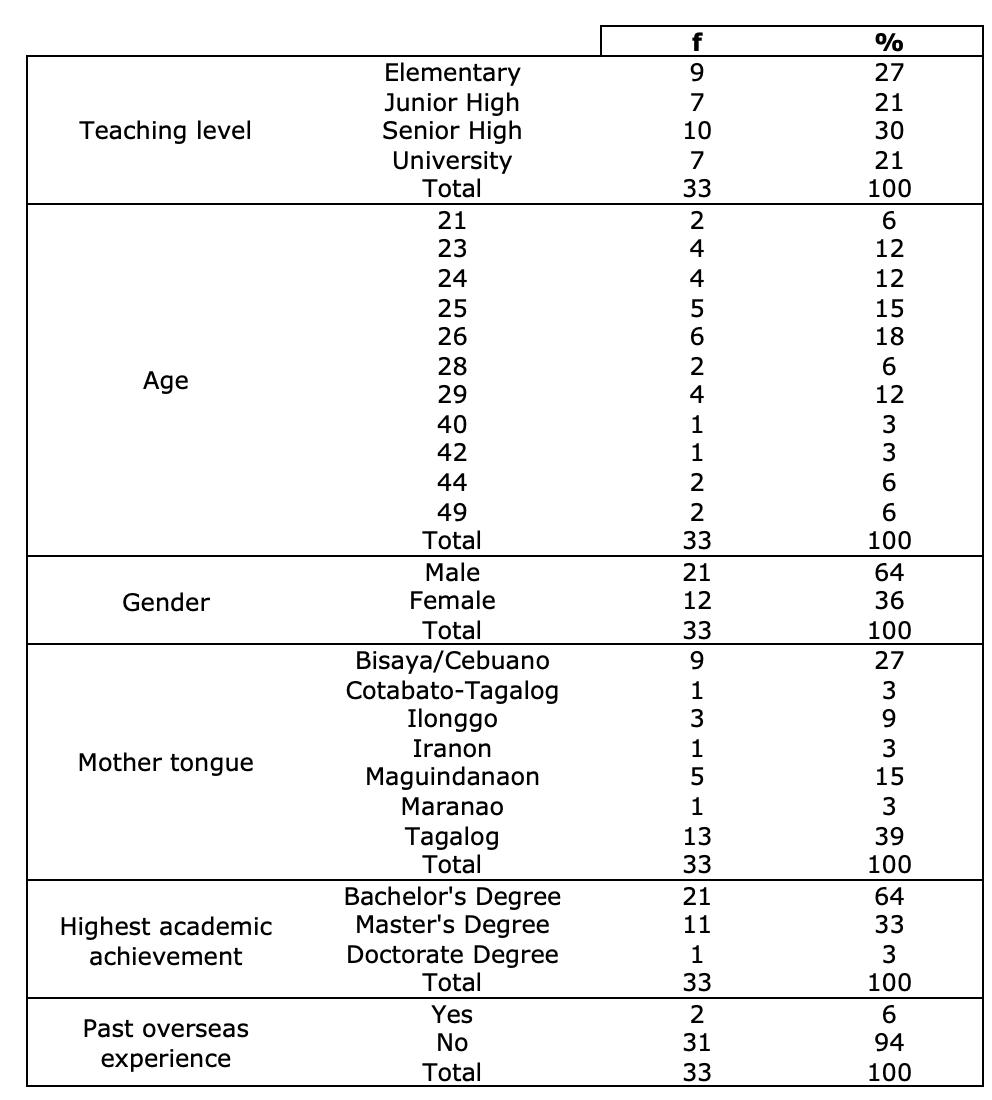
Table 1: Profiles of the teachers
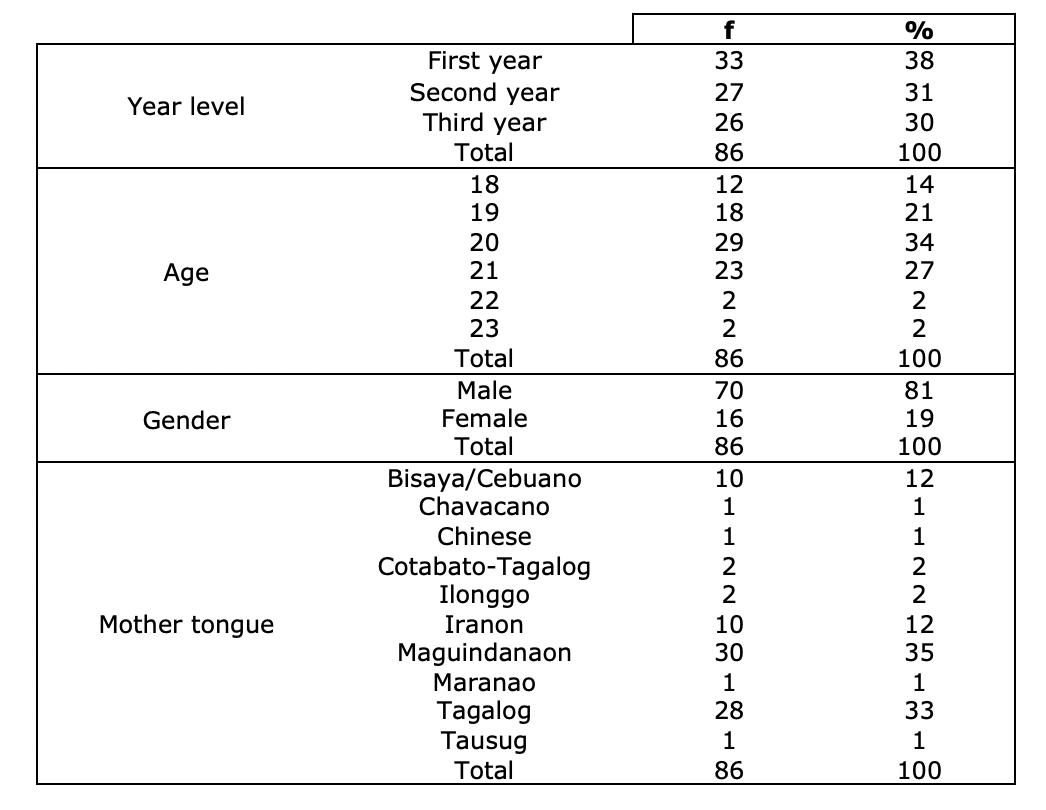
Table 2: Profiles of the students
Material
The present study adapted the questionnaire of Bautista (2001a,b) to determine the attitudes of both teacher- and student-respondents. A majority of the reviewed studies above also employed such a tool in their undertakings (e.g., Bernardo, 2014, Escalona, n.d.; Hernandez, 2020). After asking for participants' consent in the first part of the survey, the second part asked the respondents to respond to 17 attitude statements toward PE using a 4-point Likert scale. This section received a .763 reliability result after a pilot test. The respondents were also asked in the third section to identify whether certain PE expressions culled from the literature on PE are acceptable in spoken and written discourses. It should be noted that we included those recent PE expressions added by Hernandez (2020) in her tool she also adapted from Bautista’s questionnaire. The fourth section asked the respondents to indicate the English variety they spoke and the variety they believed should be learned and used in particular situations. After a pilot test, this part had a .818 reliability result. Lastly, the fifth part asked for the personal, educational, and language backgrounds of the respondents.
Procedure
After acquiring the consent of the administrators of the different departments from which the respondents came, informed consent forms were given to the respondents. These explained the purpose and procedures of the research, described confidentiality, and confirmed the voluntary participation of the respondents. Upon receiving the consent forms of those who opted to participate in the study, the survey questionnaire was then administered to them online through Google Forms. After collecting and retrieving the data from the Google Forms, the responses were recorded by applying descriptive statistics, such as mean, frequency, and percentage. To test the significant differences between the attitudes of the respondents as revealed in the different sections of the survey, different non-parametric tests were used.
Results
The presentation of the findings follows the order of the sections of Bautista’s (2001a, b) attitudinal questionnaire used in the current investigation while comparing the attitudes of the teachers and students and their attitudes when grouped according to their teaching and year levels, respectively.
Teacher and students’ attitudes toward PE using a scale
Part A of the questionnaire consists of a 17-item Likert Scale with four choices - Strongly Disagree (SD), Disagree (D), Agree (A), and Strongly Agree (SA). The items were categorized by Bautista (2001a) according to sections that focused on negative items toward PE (Items 1 to 5), positive items toward PE (Items 6 to 11), positive items toward AE (Items 12 to 15), and neutral items toward PE and AE (Items 16 to 17).
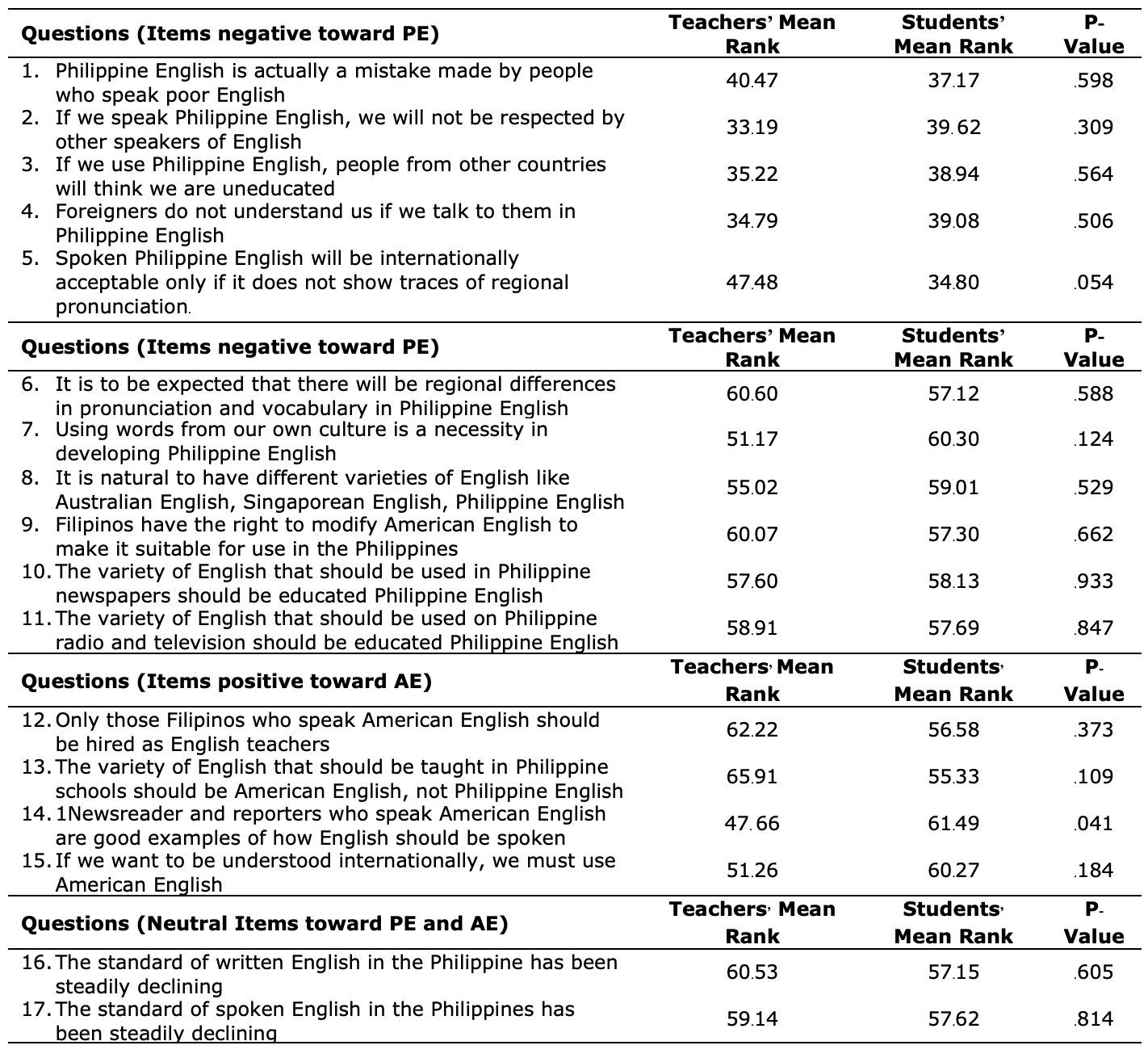
Table 3: Teachers’ and students’ attitudes toward PE and AE
As seen in Table 3, the Mann-Whitney test revealed that questions 1-5 which evaluated people’s negative attitudes to PE yielded no significant differences between the teachers and students as revealed by their p-values which are all higher than the set alpha (?=0.05). Although the mean ranks of students are higher most of the time, indicating their tendency to negatively regard PE, their responses are still not statistically different from that of the teachers. Both groups echo the study of Bautista (2001a) and Hernandez (2020) whose respondents highly rejected the unfavorable statements toward PE. Generally, both groups of respondents strongly adhere to the PE variety and firmly believe that it is a widely acceptable variety.
Their favorable attitudes toward PE are also amplified by their responses to the positive items toward PE. That is to say, the Mann-Whitney test revealed Items 6-11 received no significant differences between the groups. Both have almost equally high mean ranks, which indicate a favorable attitude towards PE variety. This finding is parallel with Bautista’s (2001a) and Hernandez’s (2020) studies, pointing to the consistency of the acceptance of PE in their claims that PE is attributed as a legitimate English variety. Escalona (n.d.) also claimed that there is an acceptance of and adherence to PE in his study. More often than not, both teachers and students consider the assimilation of PE and they accept PE as an educated variety to be used based on the general ideas of the perceived items.
For items positive toward AE, the Mann-Whitney test disclosed no significant differences in Items 12, 13, and 15. However, the item about accepting AE as the standard of English use in mass media is statistically significant between the groups. The mean rank of students is higher than that of teachers, demonstrating a significantly higher level of agreement of the former group than that of the latter group. The data are comparable with Bautista (2001b) in that, although both teachers and pre-service teachers disagreed with Item 14, a lower level of disagreement in the statement was found among the teachers. This item is a specific reference to the pronunciation of media journalists. Put differently, students appear to adhere to the AE variety as their model in appropriating English use in the context of mass media.
Bautista (2001a) also noted that her respondents were still not categorically disregarding AE based on their responses to Items 13-15. In the present study, the students could be viewing mass media as another helpful source of learning AE. Mass media may also be a powerful tool in shaping the students’ Americanized tongue through the formal domain of English use that news reports provide. Moreover, the students may have had lesser exposure and knowledge about WE compared to the teachers, since the latter could have studied and gained experience about varieties of English in their field of teaching and/or research work.
Finally, the last two items which were neutral toward PE and AE showed no statistical difference between the two groups, even though the mean ranks of the faculty are slightly higher, underscoring a tendency of agreement towards the items. Bautista (2001b) likewise found her teacher-respondents to have a higher level of agreement. Essentially, this finding may imply that teachers are undecided about whether PE should be recognized in the writing or speaking domain.
To substantiate these claims, the teaching level of the teachers and year levels of the students were also considered. The Kruskal-Wallis test revealed that all the questions in the first part of the survey yielded no significant differences across the teachers’ levels and students’ levels. Examining the mean ranks of the four groups of teachers, it was seen that there was also no consistent or salient pattern as to which level of a group tended to have the highest mean ranks. Hence, at this point of our analysis, the levels of the teachers and students are not yet clear.
Teacher and students’ overall ratings toward PE for spoken and written modes
The respondents were also given the same set of expressions and lexical items in PE in Part C of the questionnaire (see Appendix 1 for Part C of the questionnaire). They were asked to check the items that they considered acceptable as part of educated PE in spoken (informal) and written (formal) forms.

Table 4: Teachers and students’ overall ratings of PE expressions for spoken and written modes
As Table 4 shows, the Mann-Whitney test disclosed that the level of acceptance of the PE expressions had no significant differences between the teachers and students for the spoken mode. For the written mode, on the other hand, the level of acceptable PE expressions in the student group was statistically higher. This result is parallel to that of Hernandez (2020) where PE lexical items were considered as educated PE by the Filipino graduate students. This supports the initial finding above about having a slight hesitation of PE acceptance to written mode, which is a similar note made by Bautista (2001a) and Gustilo and Dimaculangan (2018). In other words, both teachers and students have favorable attitudes toward PE lexicons; however, there is some uncertainty especially among teachers in accepting some lexical expressions in a formal written context.

Table 5: Overall ratings of teachers across teaching levels toward PE expressions for spoken and written modes
Concerning the teachers’ teaching levels, Table 5 shows their overall ratings. While the overall responses about the written mode had no significant differences, suggesting that almost all of the teacher respondents had the same principles when it came to the formal written context in academic work, the Kruskal-Wallis test revealed significant differences in generally accepting PE items in the spoken mode. Specifically, the university level teachers responded with the highest mean rank, while the elementary teachers had the lowest. This could infer that the university teachers were appropriating more PE items as expressions to be used in informal context (spoken discourse), and that they were stricter about accepting PE items in the formal context (written domain). In this case, the teacher’s level can be a factor, specifically in that those who were teaching at the highest level of education had reservations about accepting PE linguistic items in the formal domain or written mode.

Table 6: Overall ratings of students across year levels toward PE expressions for spoken and written modes.
In the case of the students’ year levels, all enrolled in a Bachelor of Secondary Education with specialization in English, Table 6 details their overall ratings. The Kruskal-Wallis test revealed no significant differences among the groups, denoting that the acceptability level of PE words in both spoken and written mode did not vary when the student’s year level was considered. All the students seem to have a similar degree of evaluating PE expressions in terms of using them. Conclusively, the students have no signs of showing a dichotomy between formal and informal domains of communication. Regardless of their year level, they accepted PE items without any reservation.
Teachers and students’ attitudes toward PE in comparison with other varieties of English using multiple choice
Table 7 presents a comparison of the attitudes of the teachers and students towards PE in relation to other varieties of English. Five questions were presented in Part D of the questionnaire. They were given four options – American English (AE), Philippine English (PE), British English (BE), and others. Based on Bautista (2001a), the Mix PE signifies for those respondents that selected one variety of English in addition to PE (e.g., PE & AE or PE & BE).
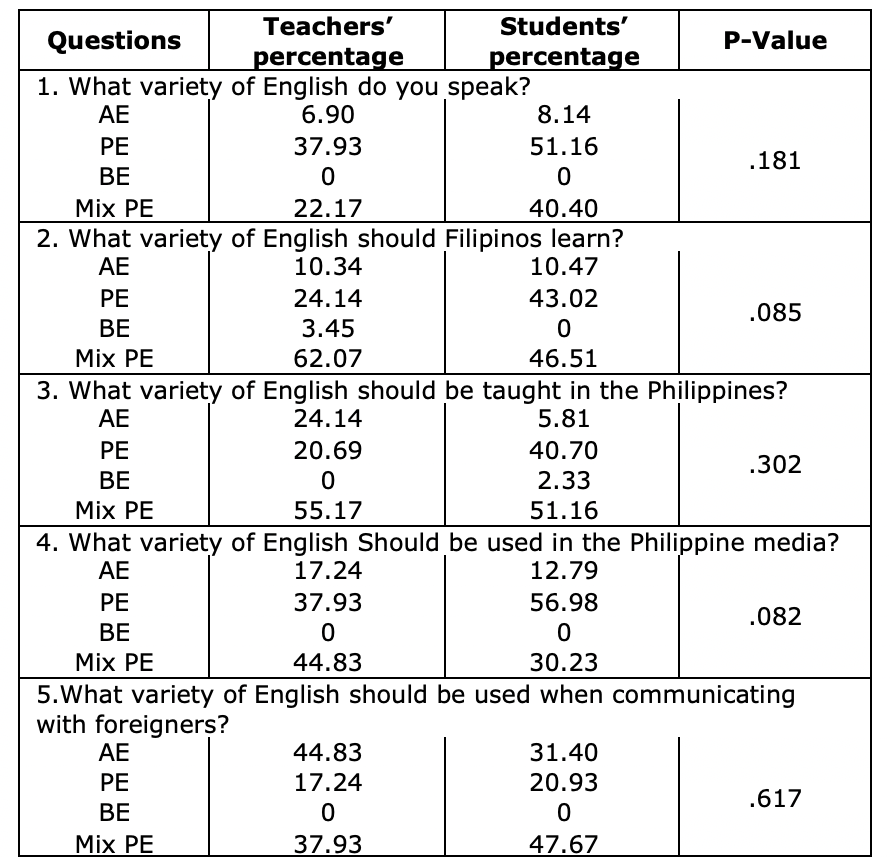
Table 7: Teachers’ and students’ attitudes towards PE in relation to other English varieties
The findings using the Mann Whitney test show that Questions 1-5 yielded no significant differences between teachers and students as shown in their respective p-values. Upon examining the descriptive statistics in the item about the variety of English spoken by the respondents, a majority of the teachers reported speaking mixed PE, while students reported speaking PE, echoing Bautista (2001a,b). This suggests that teachers have a tendency to also recognize the prestige of the other varieties apart from their own varieties of English maybe because they are teachers who need to show more expertise in shuttling between varieties to accommodate to varieties of English in their classes or day-to-day communication.
On the variety of English Filipinos should learn and that should be taught in the Philippines, both teachers and students mostly preferred mixed PE. In this case, complete independence of recognizing PE as our own variety is not evident. In particular, external control of AE or BE still exists when PE is placed in the context of education in the country. Thus, a hybrid variety is something they may be perceived as practical to be learned as it probably helps Filipinos keep being adaptive and accommodating to their interlocutors in their conversations. “Linguistic insecurity” is what Bautista (2001b) termed such a phenomenon when she found that her respondents might still view AE or BE as the ideal varieties for Filipinos in spite of their recognition of their speaking as a reflection of PE. If this is the case, an eclectic approach to teaching could be viewed as more relevant in teaching and learning, an idea that is even advocated by past PE scholars to make learners not only PE-aware but also WE-aware.
On the English variety to be used in Philippine media, most of the teachers preferred mixed PE while a majority of the students responded PE. This finding is opposite to the case of the students described earlier as the ones giving AE prestige as an example of a great exemplification of speaking in mass media. In other words, this diverging note suggests that both groups still give more value to AE or BE in the context of mass media. However, Bautista (2001b) had an opposite observation in her study where her teacher- and student-respondents preferred the Philippine media use PE.
A majority of the teachers responded that AE should be used when communicating with foreigners, while most students preferred mixed PE. All these proportions seen to show that Filipinos are indeed flexible and willing to use other varieties of English to accommodate the speaking needs of people foreign to them. Teachers also were believed that AE is more intelligible in communicating with foreigners while students preferred to assert their own identity when speaking to other nationalities.
Turning to teachers at different education levels, Table 6 presents their responses to the third section of the survey.
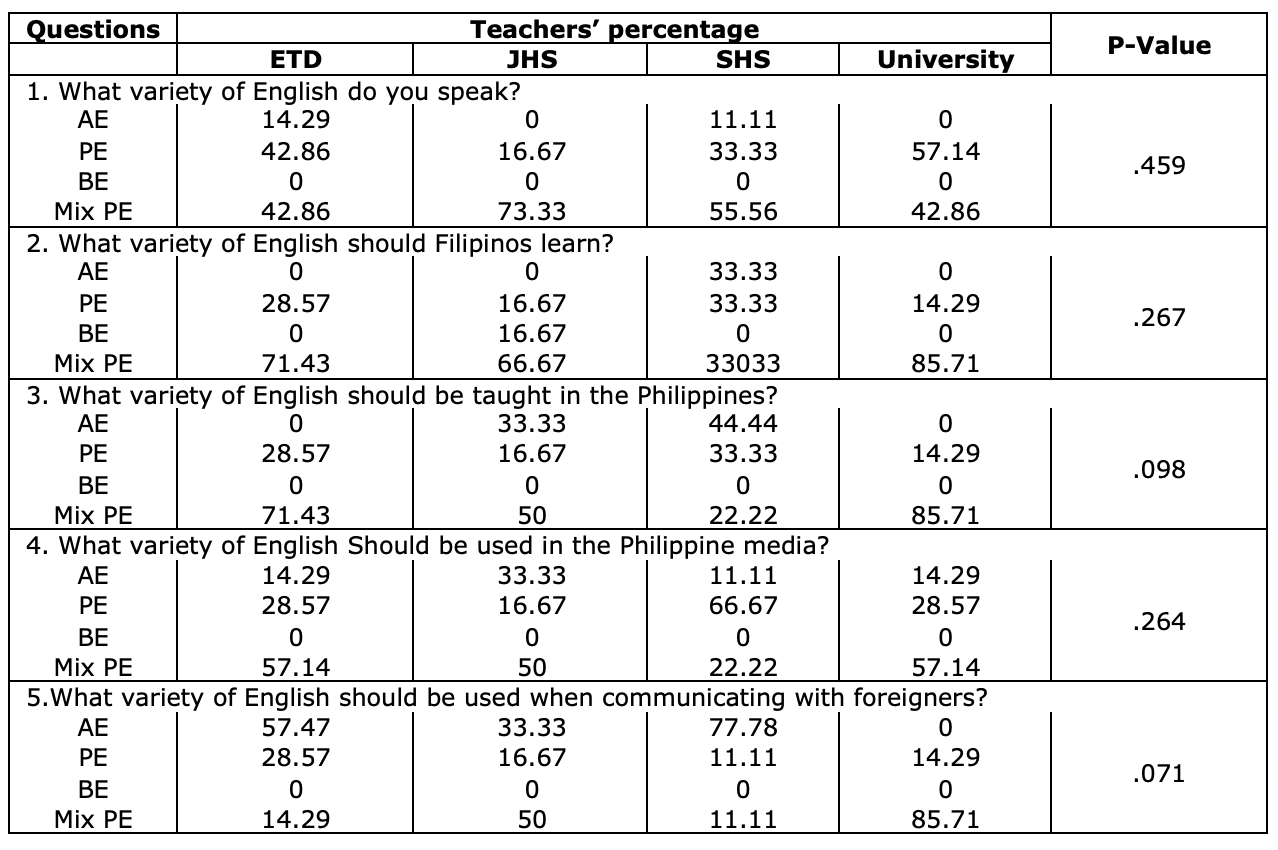
Table 8. Attitudes of teachers across teaching levels towards PE in relation to other English varieties: ETD-Elementary, JHS-Junior High School, SHS-Senior High School, University
The Kruskal-Wallis test calculated that the teacher groups do not statistically vary in all the items 1-5. Looking at the percentages of the four groups, there is one striking observation among the tertiary teachers that cannot be oversimplified. As for the variety they speak, most of the teachers reported using mixed PE, with the JHS group having the highest number. The tertiary teachers, on the other hand, showed the highest percentage in claiming that they speak PE. However, these are the teachers who turned out to be the lowest in selecting PE as the variety that should’be learned by Filipinos and taught in the Philippines. Further, they were second to the lowest in percentage when considering PE as the variety that should be used in the Philippine media and when communicating with foreigners. On another note, they consistently emerged the highest in percentage in selecting mixed PE in such four ‘should’ items. It seems that although the tertiary teachers claimed to speak PE, their reservations about their own variety are noticeable when it comes to typifying it as the variety that should be used for academic purposes (Items 2 and 3) and the every day communication (Items 4 and 5). The statistical calculation may not have provided any significant difference among the teacher groups, but these responses of the tertiary teachers shape their identity as users of PE who show reluctance to accept PE in practice. This hesitation may stem from their certain level of awareness of WE, which reminds them that other English varieties are as important and relevant in teaching and real-world communication.
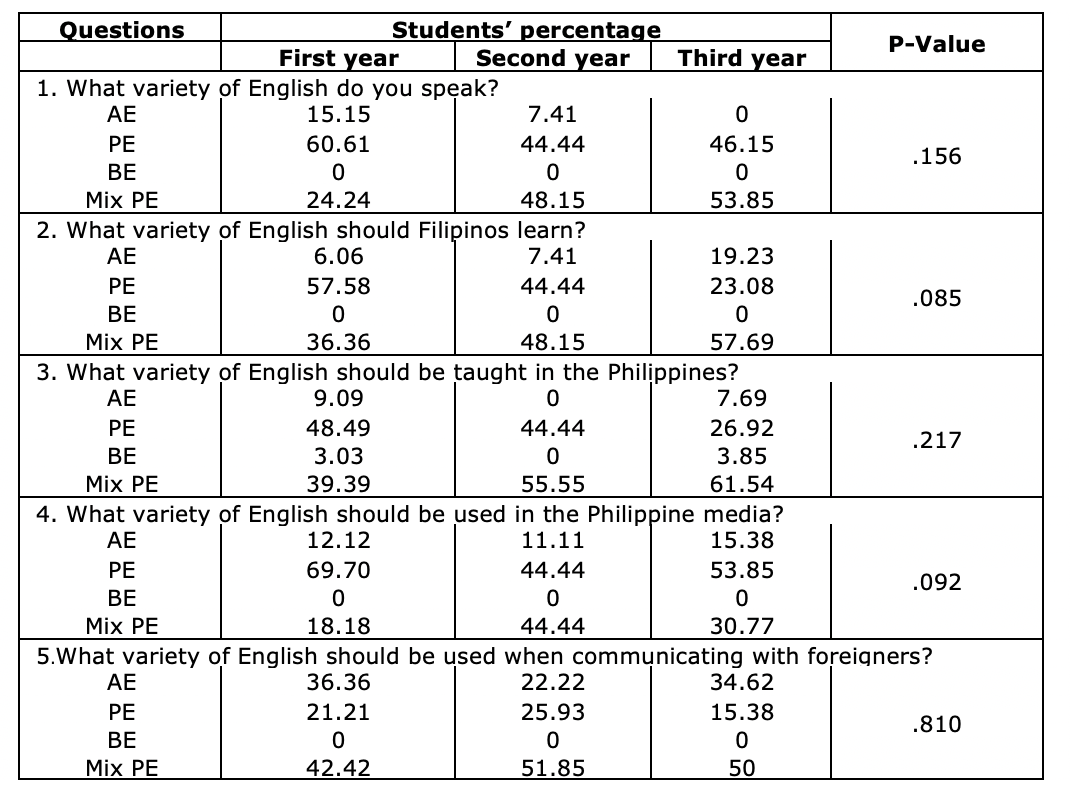
Table 9: Attitudes of students across year levels towards PE in relation to other English varieties
As to the student levels, the Kruskal-Wallis test showed no significant differences among the groups, as reflected in their p-values found in Table 9. Hence, the students do not statistically vary in all five items. In viewing the percentages of the students, no stable pattern surfaced. Throughout the items, either PE or Mix PE received highest percentages. It is the first-year students who produced the highest percentage in PE more often than not, while the third-year students occasionally had highest proportion in Mix PE. Despite these patterns, the first- and third-year students appeared second or last in percentage in only a few items. It seems that the students’ year level did not play any pivotal role in the expression of their views as to what variety they spoke, what should be learned and taught, and what should be used in media and communicating with foreigners. Moreover, students appeared to recognize PE as a legitimate variety of their own based on the observation that either PE or Mix PE is placed highest in percentage.
Discussion and Conclusion
What do these recurring patterns say about the existence of Philippine English (PE) as perceived by English language teachers and students? Welcoming PE within the system of PE users is obvious. They are aware that PE exists alongside the other “standardized” varieties of English. This means that familiarity with PE likewise extends even among Filipinos living in the southern area of the Philippines, despite the observation of multiple languages in the region. PE can then be seen as a reflection of Filipinos’ identity (Borlongan, 2009) as the respondents mostly showed positive regard towards PE, distinguishing themselves as Filipino users of the English language. Indeed, PE is alive (Gustilo et al., 2019). However, certain findings and claims mentioned above point to very significant impressions. In particular, there seems to be reluctance among the teachers to legitimatize PE. Two conclusions can be made from this. First, it is evident that the teachers are also sensitized to American English (AE) and/or British English (BE) as the “conventional” varieties embraced in the country. In practice, they may then want to see PE in conjunction with AE and/or BE in teaching and their own speech. This should not be viewed negatively, as other PE scholars in the country also advocate this teaching approach (e.g., Bernardo, 2013, 2014, 2018). Second, this behavior has already been found in the past attitudinal research. Platt et al. (1994, as cited in Bautista, 2001a) labeled it as ‘the teacher’s dilemma,’ which means that although teachers recognize PE as a separate, legitimate variety of English, accepting certain PE expressions in the formal context of communication and regarding PE as a variety that “should” be embraced in an academic context and practical use are not completely accepted by them. Moreover, Baumgardner (1995, as cited in Bautista, 2001a) pointed out that there is a difference between ideal behavior and actual behavior, implicating that teachers in the present study are aware that PE is a distinctive characteristic of being a Filipino; however, they also opt to embrace other varieties in their actual behavior. Being inclined to the “native speakerism” mindset of PE users is not a surprise because of the established notion that “standardized” English appears to dominate English language teaching (ELT) programs in the Asian educational context that was colonized by the American and British empires (Tarrayo et al., 2021). Tarrayo et al. suggested the term “cognitive disequilibrium” to describe a tension between the inner circle varieties and Thai English based on Thai teachers’ perceptions.
In the present study, the acceptance of PE among the teachers could play a role in their attitudes and be related to the level of education they teach. The results of the current research show that the tertiary teachers appeared to show some hesitation in fully acknowledging and applying PE in their system of communication, since they understood of the importance of being World English (WE) teachers. But as far as completely advocating PE as a separate, legitimate variety of English is concerned, teachers’ pedagogical practices may vary. In particular, a theoretical valuing of PE is evident among the teachers, but they do not categorically apply their full intention of legitimatizing PE when confronted with real formal communication. This gap between theory and practice deserves a space in scholarly conversations. Specifically, the teaching level of education should be valued. This article emphasized that tertiary teachers were stricter than basic education level teachers in accepting PE expressions in a formal context. They likewise recognized that they spoke PE, yet their stance on what variety ‘should’ be learned, taught, and used in media and interpersonal communication showed their preference for either AE or mixed PE. Needless to say, being aware of PE does not guarantee acceptance of PE (Martin, 2014b). Unfortunately, this constraint is more common in the behavior of tertiary teachers who should be the ones to use PE in academic discourse with their language students who will soon become language teachers and PE advocates. Consequently, the state of attitudes of users toward their own English variety could be labeled as a cognitively-ascending dilemma, that is, as they become more aware of the infrastructure of an English variety, their reluctance to unreservedly make it part of their language system and/or identity appears. It is conjectured, therefore, that their increasing knowledge also comes with their flexibility in treating or accepting an idea as a theory or fact, showing their cautiousness of the flourishing and competing concepts present in their growing cognition.
Pedagogically speaking, the importance of being PE- and WE-aware in teaching should not be undermined. A pluricentric teaching approach is necessary for sensitizing students to intercultural communication to thrive both locally and globally. A recalibration of the Philippine English language curriculum at all levels of education is paramount by placing more value on PE, since the basic education level teachers in the present study viewed PE positively most of the time. However, the teachers’ mindsets in terms of putting PE infrastructure into real practice needs also to be adapted. It is expected that the teachers, particularly those at the higher level of education, need to serve as examples by unreservedly making PE part of their identity as Filipino users of the English language. In Mindanao, teachers in the region to have an increased awareness of the existence and acceptance of PE both inside and outside the classroom to reinforce PE legitimization throughout the country. By doing so, PE will soon reach the differentiation stage of English variety vis-à-vis the dynamic model of Schneider (2003, 2007).
For future studies, it is suggested that more attitudinal studies can be done in different places or regions and with different professionals in the Philippines to augment the number of Filipino-respondents, since the present study is limited to one university in a single Southern area of the country. The other demographics of English variety users is a good source of explaining further the status of PE, such as the association of the users’ proficiency to their attitudes by applying different quantitative tests and qualitative analysis for a more conclusive understanding of the status of the English variety. Other qualitative approaches may likewise be used, such as classroom observation of the actual English language variety used by the teachers and students and how the teachers pedagogically respond to students who (un)consciously use an English variety. Finally, the findings and discussion of the current survey mostly highlighted the general attitudes of the respondents based on the used questionnaire. Future researchers may consider analyzing the items reflected in the questionnaire to further an enriched discussion of the sociolinguistic realities surrounding PE.
References
Agheyisi, R., & Fishman, J. A. (1970). Language attitude studies: A brief survey of methodological approaches. Anthropological Linguistics, 12(5), 137–157. http://www.jstor.org/stable/30029244
Alieto, E. O., & Rillo, R. M. (2018). Language attitudes of English language teachers (ELTs) towards Philippine English. Journal of Humanities and Social Sciences, 13(10), 84–110.
Baker, C. (1992). Attitudes and languages. Multilingual Matters.
Barcelos, A. M. F., & Kalaja, P. (2013). Beliefs in second language acquisition: Teacher. In C. A. Chapelle (Eds.), The Concise Encyclopedia of Applied Linguistics. Wiley.
Bautista, M. L. S. (2001a). Attitudes of English language faculty in three leading Philippine universities toward Philippine English. Asian Englishes, 4(1), 4–32. https://doi.org/10.1080/13488678.2001.10801062
Bautista, M. L. S. (2001b). Attitudes of selected Luzon university students and faculty towards Philippine English. In M. L. G. Tayao, T.P. Ignacio, & G. S. Zafra (Eds.), Rosario E. Maminta in focus: Selected writings in applied linguistics, (pp. 263–273).The Philippine Association for Language Teaching.
Bautista, M. L. S., & Gonzalez, A. B. (2006). Southeast Asian Englishes. In B. B. Kachru, Y. Kachru, & C. L. Nelson (Eds.), The Handbook of World Englishes (pp. 130–144). Wiley.
Bernardo, A. S. (2013). Toward an endonormative pedagogic model for teaching English in Philippine higher education institutions [Unpublished doctoral dissertation]. University of Santo Tomas.
Bernardo, A. S. (2014). Changing and changed stance toward norm selection in Philippine universities: Its pedagogical implications. Journal on English Language Teaching, 4(3), 26–37. https://doi.org/10.26634/jelt.4.3.2859
Bernardo, A. S. (2018). An endocentric approach to English grammar teaching. In I. P. Martin (Ed.), Reconceptualizing English education in a multilingual society: English in the Philippines (pp. 101–118). Springer.
Bohner, G., & Wanke, M. (2002). Attitudes and attitude change. Psychology Press.
Bolton, K. (2008). English in Asia, Asian Englishes, and the issue of proficiency. English Today, 24(2), 3-12. https://doi.org/10.1017/S026607840800014X
Borlongan, A. M. (2009). A survey on language use, attitudes, and identity in relation to Philippine English among young generation Filipinos: An initial sample from a private university. The Philippine ESL Journal, 3, 74–107.https://files.eric.ed.gov/fulltext/ED505885.pdf
Borlongan, A. M. (2016). Relocating Philippine English in Schneider’s dynamic model. Asian Englishes, 18(3), 232–241. https://doi.org/10.1080/13488678.2016.1223067
Borlongan, A., & Dita, S. (2015). Taking a look at expanded predicates in Philippine English across time. Asian Englishes, 17(3), 240–247. https://doi.org/10.1080/13488678.2015.1069965
Canilao, M. L. E. N. (2020). Foregrounding Philippine Englishes in fostering linguistic equality. Asian Englishes, 22(2), 195–215. https://doi.org/10.1080/13488678.2020.1715575
Dimaculangan, N. G. (2018). Another look into Philippine English: Towards users’ awareness and celebration. International Journal of Advanced Research and Publications, 2(8), 17–22.
Dita, S. N. (2025). The grammar of Philippine English: An update. In S. Rüdiger, T. Neumaier, S. Leuckert, & S. Buschfeld (Eds.), World Englishes in the 21st century: New perspectives and challenges to the dynamic model (pp. 103–121). Edinburgh University Press.
Dita, S. N., & De Leon, K. D. (2022). Intelligibility. In A. M. Borlongan (Ed.), Philippine English: Development, structure, and sociology of English in the Philippines (pp. 221–230). Routledge.
Doplon, F. P. G. (2018). The supremacy of English in Philippine language education policy. In I. P. Martin (Ed.), Reconceptualizing English education in a multilingual society: English in the Philippines (pp. 29-46). Springer.
Eagly, A. H., & Chaiken, S. (2005). Attitude research in the 21st century: The current state of knowledge. In D. Albarracín, B. T. Johnson, & M. P. Zanna (Eds.), The handbook of attitudes (pp. 743–767). Lawrence Erlbaum Associates Publishers.https://psycnet.apa.org/record/2005-04648-018
Escalona, S. L. (n.d.). Attitude towards Philippine English: A case of BSU English teachers [Unpublished article]. Downloaded from academic.edu.
Fasold, R. W. (1984). The sociolinguistics of society. Blackwell.
Garrett, P. (2010). Attitudes to language. Cambridge University Press.
González Cruz, I., & Luján-García, C. I. (1997). On attitudes, the driving force in EFL and EWL studies. LFE: Revista de Lenguas para Fines Específicos, (4), 185–208.
Gustilo, L., & Dimaculangan, N. (2018). Attitudes of Filipino English teachers toward 21st century Philippine English writing. Advanced Science Letters, 24(11), 8349–8352. https://doi.org/10.1166/asl.2018.12560
Gustilo, L., Tocalo, A. W., & Calingasan, K. A. (2019). The intelligibility and acceptability of internet Philippine English (IPE): Their implications to English language teaching in the new English varieties. Asian EFL Journal, 21(2), 83–104.
Hernandez, H. P. (2020). Filipino graduate students’ attitudes toward teaching educated Philippine English: A sample from a premier teacher education institution. Asia-Pacific Social Science Review, 20(1), 31–42. https://doi.org/10.59588/2350-8329.1280
Kachru, B. B. (1992). World Englishes: Approaches, issues and resources. Language Teaching, 25(1), 1–14. https://doi.org/10.1017/S0261444800006583
Kirkpatrick, A. (2015). The future of English in Asia. In M. O’Sullivan, D. Huddart, & C. Lee (Eds.), The future of English in Asia: Perspectives on language and literature (pp. 31-47). Routledge.
Lambert, W. E. (1967). A social psychology of bilingualism. Journal of Social Issues, 23(2), 91–109.https://doi.org/10.1111/j.1540-4560.1967.tb00578.x
McKenzie, R. M. (2010). The social psychology of English as a global language: Attitudes, awareness and identity in the Japanese context. Springer.
Martin, I. P. (2014a). English language teaching in the Philippines. World Englishes, 33(4), 472–485. https://doi.org/10.1111/weng.12108
Martin, I. P. (2014b). Philippine English revisited. World Englishes, 33(1), 50–59. https://doi.org/10.1111/weng.12054
Martin, I. P. (2018). Reconceptualizing English education in multilingual Philippines. In I. P. Martin (Ed.), Reconceptualizing English education in a multilingual society: English in the Philippines (pp. 3–11). Springer.
Pajares, M. F. (1992). Teachers’ beliefs and educational research: Cleaning up a messy construct. Review of Educational Research, 62(3), 307–332. https://doi.org/10.3102/00346543062003307
Ponce, A. R. (2025). Colonial mindset, appropriation, and emotion: Language attitudes towards English of multilingual speakers in southern Philippines. International Journal of Multilingualism, 1-17. https://doi.org/10.1080/14790718.2025.2475371
Richardson, V. (1996). The role of attitudes and beliefs in learning to teach. In J. Sikula (Ed.), Handbook of research on teacher education (2nd ed., pp. 102–119). Macmillan.
Schneider, E. W. (2003). The dynamics of new Englishes: From identity construction to dialect birth. Language, 79(2), 233–281. https://www.jstor.org/stable/4489419
Schneider, E. W. (2007). Postcolonial English: Varieties around the world. Cambridge University Press.
Tarrayo, V. N., Ulla, M. B., & Lekwilai, P. (2021). Perceptions toward Thai English: A study of university English language teachers in Thailand. Critical Inquiry in Language Studies, 18(4), 374–397. https://doi.org/10.1080/15427587.2021.1919113
Tupas, R. (2014). Inequalities of multilingualism: Challenges to mother-tongued based multilingual education. Language and Education, 29(2), 112–124. http://dx.doi.org/10.1080/09500782.2014.977295
Tupas, R., & Weninger, C. (2020). Mapping out unequal Englishes in English-medium classrooms. Journal of Language, Identity & Education, 21(5), 347–361. https://doi.org/10.1080/15348458.2020.1795863
Wattananukij, W., & Crabtree, R. M. (2020). Language attitudes toward Philippine English: A comparative study among Thai undergraduate students with and without exposure to Philippine English teachers. NIDA Journal of Language and Communication, 25(37), 18–40. https://lcjournal.nida.ac.th/main/public/abs_pdf/journal_v25_i37_2.pdf